Accurate prediction of disease risk using genomics enables earlier identification of individuals at elevated risk and facilitates more effective prevention strategies. However, existing genetic approaches show limited generalizability across cohorts and lack biological interpretation. We develop robust and biologically interpretable models using high-dimensional data.
Systematic integration of genomic annotations into predictive models
Biologically interpretable sparse models for genetic prediction of disease
Flexible predictive modeling applicable across distinct contexts
In this study, led by Xiaohe (Lucy) Tian, we showed that ancestry-aware integration of tissue-specific genomic annotations enhances the transferability of polygenic scores (PGS).
We developed a polygenic score training approach that allows direct inclusion of admixed individuals without the need for local ancestry inference and showed ancestry-diverse …
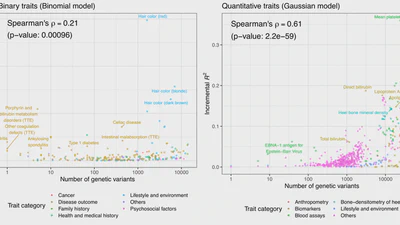
We performed a systematic assessment of the predictive performance of PRS models across >1,500 traits in UK Biobank and report 813 PRS models with significant predictive …