Diagnosis for the same disease affects individuals differently. However, we don’t know how best to represent biologically meaningful axes of variation within a disease, beyond the standard case vs. control comparison or proxy measure of severity. We combine human genetics, causal inference, and modern AI to address this challenge.
Decomposition of genetic associations across many phenotypes
Causal representation learning from pleiotropic associations
Assessing the biological bases of disease subtypes
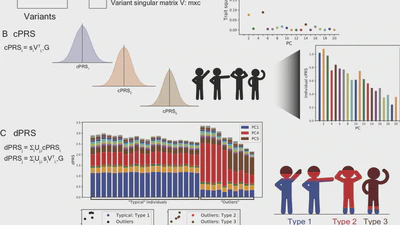
Polygenic risk score (PRS) has been proposed for disease risk prediction with potential clinical relevance for some traits, but its personalized interpretation is generally …
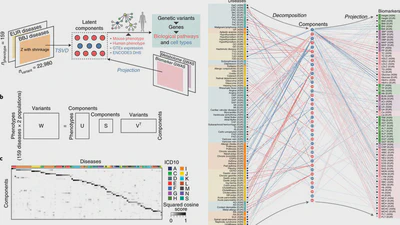
Using a set of GWAS summary statistics of diseases characterized from both European (UK Biobank and FinnGen) and East Asian (Biobank Japan) populations, we dissected latent DeGAs …