Integration of rare expression outlier-associated variants improves polygenic risk prediction
Jun 2, 2022
·
1 min read
Authors
C Smail, NM Ferraro, Q Hui, MG Durrant, M Aguirre, Y Tanigawa, MR Keever-Keigher, AS Rao, JM Justesen, X Li, MJ Gloudemans, TL Assimes, C Kooperberg, AP Reiner, J Huang, CJ O'Donnell, YV Sun, Million Veteran Program, MA Rivas, SB Montgomery
Abstract
Polygenic risk scores (PRSs) quantify the contribution of multiple genetic loci to an individual's likelihood of a complex trait or disease. However, existing PRSs estimate this likelihood with common genetic variants, excluding the impact of rare variants.
Polygenic risk scores (PRSs) quantify the contribution of multiple genetic loci to an
individual’s likelihood of a complex trait or disease. However, existing PRSs estimate
this likelihood with common genetic variants, excluding the impact of rare variants.
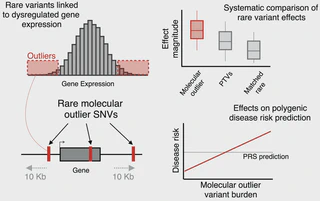
Here, we report on a method to identify rare variants associated with outlier gene
expression and integrate their impact into PRS predictions for body mass index (BMI),
obesity, and bariatric surgery. Between the top and bottom 10%, we observed a 20.8%
increase in risk for obesity (p = 3 × 10-14), 62.3% increase in risk for severe obesity
(p = 1 × 10⁻⁶), and median 5.29 years earlier onset for bariatric surgery (p = 0.008),
as a function of expression outlier-associated rare variant burden when controlling for
common variant PRS. We show that these predictions were more significant than
integrating the effects of rare protein-truncating variants (PTVs), observing a mean 19%
increase in phenotypic variance explained with expression outlier-associated rare
variants when compared with PTVs (p = 2 × 10-15). We replicated these findings by using
data from the Million Veteran Program and demonstrated that PRSs across multiple traits
and diseases can benefit from the inclusion of expression outlier-associated rare
variants identified through population-scale transcriptome sequencing.
Type
Publication
Published in The American Journal of Human Genetics, 2022
Polygenic risk score (PRS), an approach to estimate genetic liability to complex traits by aggregating the effects across multiple genetic variants, has attracted increasing research interest.
