Sex-specific genetic effects across biomarkers
Sep 1, 2020
·
1 min read
Authors
E Flynn, Y Tanigawa, F Rodriguez, RB Altman, N Sinnott-Armstrong, MA Rivas
Abstract
Sex differences have been shown in laboratory biomarkers; however, the extent to which this is due to genetics is unknown. In this study, we infer sex-specific genetic parameters (heritability and genetic correlation) across 33 quantitative biomarker traits in 181,064 females and 156,135 males from the UK Biobank study.
Sex differences have been shown in laboratory biomarkers; however, the extent to which
this is due to genetics is unknown. In this study, we infer sex-specific genetic
parameters (heritability and genetic correlation) across 33 quantitative biomarker
traits in 181,064 females and 156,135 males from the UK Biobank study. We apply a
Bayesian Mixture Model, Sex Effects Mixture Model (SEMM), to Genome-wide Association
Study summary statistics in order to (1) estimate the contributions of sex to the
genetic variance of these biomarkers and (2) identify variants whose statistical
association with these traits is sex-specific. We find that the genetics of most
biomarker traits are shared between males and females, with the notable exception of
testosterone, where we identify 119 female and 445 male-specific variants. These include
protein-altering variants in steroid hormone production genes (POR, UGT2B7). Using the
sex-specific variants as genetic instruments for Mendelian randomization, we find
evidence for causal links between testosterone levels and height, body mass index, waist
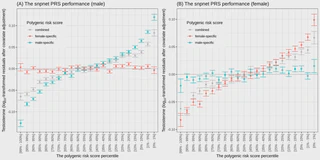
and hip circumference, and type 2 diabetes. We also show that sex-specific polygenic
risk score models for testosterone outperform a combined model. Overall, these results
demonstrate that while sex has a limited role in the genetics of most biomarker traits,
sex plays an important role in testosterone genetics.
Type
Publication
Published in European Journal of Human Genetics, 2021
In this study led by Emily Flynn, we discovered a surprising sex-specificity in the genetics of testosterone.
