Significant shared heritability underlies suicide attempt and clinically predicted probability of attempting suicide
Jan 4, 2019
·
1 min read
Authors
DM Ruderfer, CG Walsh, MW Aguirre, Y Tanigawa, JD Ribeiro, JC Franklin, MA Rivas
Abstract
Suicide accounts for nearly 800,000 deaths per year worldwide with rates of both deaths and attempts rising. Family studies have estimated substantial heritability of suicidal behavior; however, collecting the sample sizes necessary for successful genetic studies has remained a challenge.
Suicide accounts for nearly 800,000 deaths per year worldwide with rates of both deaths
and attempts rising. Family studies have estimated substantial heritability of suicidal
behavior; however, collecting the sample sizes necessary for successful genetic studies
has remained a challenge. We utilized two different approaches in independent datasets
to characterize the contribution of common genetic variation to suicide attempt. The
first is a patient reported suicide attempt phenotype asked as part of an online mental
health survey taken by a subset of participants (n = 157,366) in the UK Biobank. After
quality control, we leveraged a genotyped set of unrelated, white British ancestry
participants including 2433 cases and 334,766 controls that included those that did not
participate in the survey or were not explicitly asked about attempting suicide. The
second leveraged electronic health record (EHR) data from the Vanderbilt University
Medical Center (VUMC, 2.8 million patients, 3250 cases) and machine learning to derive
probabilities of attempting suicide in 24,546 genotyped patients. We identified
significant and comparable heritability estimates of suicide attempt from both the
patient reported phenotype in the UK Biobank (h2SNP = 0.035, p = 7.12 × 10⁻⁴) and the
clinically predicted phenotype from VUMC (h2SNP = 0.046, p = 1.51 × 10⁻²). A significant
genetic overlap was demonstrated between the two measures of suicide attempt in these
independent samples through polygenic risk score analysis (t = 4.02, p = 5.75 × 10⁻⁵)
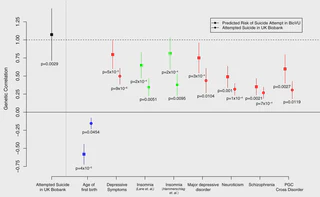
and genetic correlation (rg = 1.073, SE = 0.36, p = 0.003). Finally, we show significant
but incomplete genetic correlation of suicide attempt with insomnia (rg = 0.34-0.81) as
well as several psychiatric disorders (rg = 0.26-0.79). This work demonstrates the
contribution of common genetic variation to suicide attempt. It points to a genetic
underpinning to clinically predicted risk of attempting suicide that is similar to the
genetic profile from a patient reported outcome. Lastly, it presents an approach for
using EHR data and clinical prediction to generate quantitative measures from binary
phenotypes that can improve power for genetic studies.
Type
Publication
Published in Molecular Psychiatry, 2020
Using two independent datasets from genotyped cohorts (UK Biobank and electronic medical record (EMR) in Vanderbilt University Medical Center), we quantified the heritability estimates of suicide attempts.
