Collaborative environmental DNA sampling from petal surfaces of flowering cherry Cerasus × yedoensis ‘Somei-yoshino’ across the Japanese archipelago
Feb 19, 2018
·
1 min read
Authors
T Ohta, T Kawashima, NO Shinozaki, A Dobashi, S Hiraoka, T Hoshino, K Kanno, T Kataoka, S Kawashima, M Matsui, W Nemoto, S Nishijima, N Suganuma, H Suzuki, YH Taguchi, Y Takenaka, Y Tanigawa, M Tsuneyoshi, K Yoshitake, Y Sato, R Yamashita, K Arakawa, W Iwasaki
Abstract
Recent studies have shown that environmental DNA is found almost everywhere. Flower petal surfaces are an attractive tissue to use for investigation of the dispersal of environmental DNA in nature as they are isolated from the external environment until the bud opens and only then can the petal surface accumulate environmental DNA.
Recent studies have shown that environmental DNA is found almost everywhere. Flower
petal surfaces are an attractive tissue to use for investigation of the dispersal of
environmental DNA in nature as they are isolated from the external environment until the
bud opens and only then can the petal surface accumulate environmental DNA. Here, we
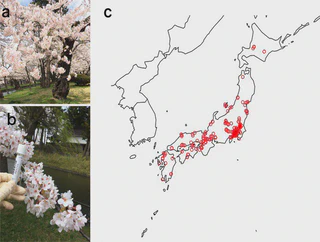
performed a crowdsourced experiment, the “Ohanami Project”, to obtain environmental DNA
samples from petal surfaces of Cerasus × yedoensis ‘Somei-yoshino’ across the Japanese
archipelago during spring 2015. C. × yedoensis is the most popular garden cherry
species in Japan and clones of this cultivar bloom simultaneously every spring. Data
collection spanned almost every prefecture and totaled 577 DNA samples from 149
collaborators. Preliminary amplicon-sequencing analysis showed the rapid attachment of
environmental DNA onto the petal surfaces. Notably, we found DNA of other common plant
species in samples obtained from a wide distribution; this DNA likely originated from
the pollen of the Japanese cedar. Our analysis supports our belief that petal surfaces
after blossoming are a promising target to reveal the dynamics of environmental DNA in
nature. The success of our experiment also shows that crowdsourced environmental DNA
analyses have considerable value in ecological studies.
Type
Publication
Published in Journal of Plant Research, 2018
Cerasus × yedoensis ‘Somei-yoshino’ is Japan’s most commonly cultivated cherry blossoms tree.
