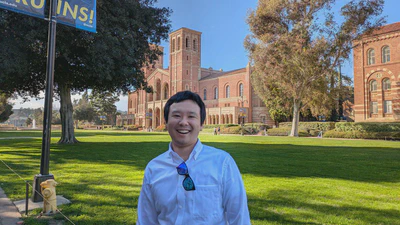
Yosuke presents at APPG 2026
Yosuke Tanigawa presents at APPG 2026, Advances in Polygenic Precision Genomics 2026.

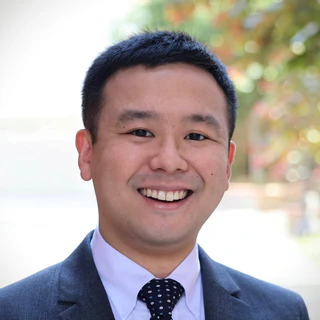
Assistant Professor
Mapping the biological basis of heterogeneity in disease.
Yosuke Tanigawa is an Assistant Professor in the Department of Bioengineering at UCLA. He leads the Tanigawa Lab, which studies why individuals with the same diagnosis differ in disease onset, progression, and treatment response.
The lab develops statistical and computational methods for large-scale genetic, genomic, and phenotypic data. The work spans disease heterogeneity dissection, ancestry-aware polygenic prediction, and therapeutic target discovery from human genetics.
Before joining UCLA in July 2025, Yosuke trained at the MIT Computational Biology Lab with Manolis Kellis. He received his PhD in Biomedical Informatics at Stanford University, where he worked with Manuel Rivas and Gill Bejerano.
The lab values scientific rigor, open science, and clear communication. We aim to make complex human genetics accessible without losing scientific precision.
Yosuke Tanigawa presents at APPG 2026, Advances in Polygenic Precision Genomics 2026.
We introduce GeneSIS, a statistical learning framework for modeling variant-level gene-by-sex interaction effects, and show it improves polygenic score prediction across 32 traits …
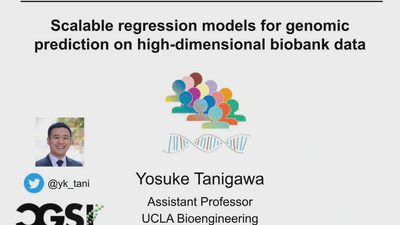
Yosuke Tanigawa presented at CGSI 2026, the Computational Genomics Summer Institute 2026.
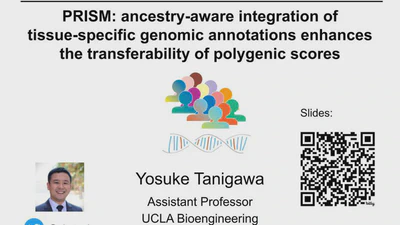
Yosuke Tanigawa presented at CGSI 2026 Retreat, the Computational Genomics Summer Institute 2026.
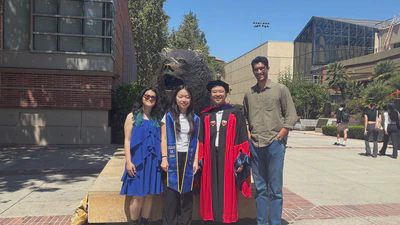
Tanya Wang graduated from UCLA with an MS in Biostatistics and will continue her next chapter at Yale.
Lei Hou and colleagues integrated peripheral immune epigenomics, whole-genome sequencing, and clinical data to study type I bipolar disorder.
Led by Bill Li, this work introduces cross-trait polygenic prediction as a strategy for using phenome-wide PGS libraries in deeply phenotyped cohorts to reveal multiple polygenic …

The Tanigawa Lab at UCLA is recruiting students and postdoctoral researchers in statistical genetics, computational genomics, and precision medicine.
How I think about mentorship, scientific training, expectations, and professional growth across career stages.
Led by Ishir Rao, this work introduces sc4D, a spatio-temporal single-cell transcriptomics framework for modeling disease progression with embedded optimal transport.